45 Christmas Trivia Questions and Answers (For Kids, Grown-Ups and That One Know-It-All Uncle)
Hi, I’m Jenny, author of The Huge Book of Amazing Facts & Interesting Stuff: Christmas Edition and The Ultimate Christmas Quiz Book. As a self-confessed Christmas nerd, I’m here to bring you some of my favourite fun facts!
A bit of background: I live in Tenerife, where “a white Christmas” means someone’s been heavy-handed with the icing sugar and the Christmas tree is quite often a palm tree wearing tinsel. Maybe that’s why I’ve gone all-in on the trivia side of things instead. I can’t give you snow, but I can tell you why Rudolph was probably a girl.
Below are 45 Christmas trivia questions, split into six rounds plus tie-breakers. The answers are underneath each round (no peeking), and every answer comes with the fun fact behind it, because “the answer is Germany” is fine, but why it’s Germany is where the good stuff is. Use them for a family quiz, a classroom, the office party, or just to win the argument at Christmas dinner.
Hosting a proper quiz night? My host’s guide to Christmas quiz night covers timings, scoring and tie-breakers, and if your team still hasn’t got a name, there are 500+ Christmas quiz team names here.
Round 1: The kids’ round (grown-ups, no “helping”)
- How many reindeer pull Santa’s sleigh, if you count Rudolph?
- Which country gave us the tradition of bringing a Christmas tree indoors?
- True or false: only boy reindeer grow antlers.
- In the UK, what do children traditionally leave out for Santa?
- How many points does a snowflake have?
- The poinsettia is famous for its bright red “petals”. What are they really?
- True or false: Santa wore red because of Coca-Cola.
Round 1 answers
- Nine. Dasher, Dancer, Prancer, Vixen, Comet, Cupid, Donner, Blitzen and Rudolph. Bonus point if you can say them all without a run-up.
- Germany. Germans were decorating trees in their homes centuries ago, and Queen Victoria’s German husband, Prince Albert, made it super fashionable in Britain in the 1840s.
- False! Female reindeer grow antlers too. Even better, most males drop theirs in early winter, while females keep theirs until spring. So if Santa’s reindeer have antlers on Christmas Eve, they’re probably girls. Sorry, Rudolph.
- A mince pie and a glass of sherry (plus a carrot for the reindeer). In the US it’s usually milk and cookies. Santa’s cholesterol doesn’t bear thinking about.
- Six. Always six, because of the way water molecules fit together when they freeze. Those eight-pointed paper snowflakes your kids made at school are scientifically inaccurate, but we love them anyway.
- Leaves! The red bits are special leaves called bracts. The actual flowers are the tiny yellow blobs in the middle. Poinsettias originally come from Mexico.
- False. Coca-Cola’s famous Santa adverts started in 1931, but Santa had already been popping up in red for decades before that. Coke definitely made him rounder and jollier though.
Round 2: Food & drink (a.k.a. my favourite round)
- What was the original “mince” in mince pies?
- True or false: it’s illegal to eat a mince pie on Christmas Day in England.
- What is a bûche de Noël?
- Who invented the Christmas cracker?
- What do people in Spain eat at midnight on New Year’s Eve, one for every chime of the clock?
- In the film Elf, what are the four main food groups?
- What’s the name of the ring-shaped cake eaten in Spain on 6 January, with a little surprise hidden inside?
Round 2 answers
- Actual meat. Medieval mince pies were stuffed with minced meat, fruit and spices. These days the only meaty thing left is (sometimes) the suet.
- False, it’s a myth. The Puritans did crack down on Christmas celebrations in the 1640s, but there’s no law about mince pies. Eat away.
- A yule log cake. It’s the French name for the chocolate log, and it’s meant to look like the real logs people used to burn over Christmas. It’s much tastier than wood.
- Tom Smith, a London sweet maker, in the 1840s. He started by wrapping sweets in twists of paper, then added the bang. The terrible jokes came later, and they’ve been terrible ever since.
- Twelve grapes. One per chime at midnight, for twelve lucky months. If you’ve ever tried it, you’ll know it’s harder than it sounds. I always end up with a mouth like a hamster’s.
- Candy, candy canes, candy corns and syrup. Honestly, it’s not far off my December diet.
- Roscón de Reyes. Spanish children get their presents from the Three Kings on 6 January, and there’s a little figure and a dried bean baked into the cake. Find the figure and you’re king for the day. Find the bean and you’re paying for next year’s roscón. We eat it here in Tenerife too, and I have a terrible track record with that bean.
Round 3: Christmas around the world
- How many Yule Lads visit children in Iceland in the run-up to Christmas?
- And what does Iceland’s Christmas Cat do?
- What is Iceland’s “Jólabókaflóð”?
- Why do some families in Norway hide their brooms on Christmas Eve?
- In Italy, who brings children presents on the night of 5 January?
- What’s the name of the scary horned creature who goes after naughty children in Austria and southern Germany?
- Why might you find spiders’ webs on Christmas trees in Ukraine?
Round 3 answers
- Thirteen. They have names like Spoon-Licker, Door-Slammer and Sausage-Swiper, and they leave small gifts in shoes (or a potato if you’ve been bad).
- Eats people who didn’t get new clothes for Christmas. Yes, really. It’s the most dramatic way I’ve ever heard of to get kids excited about socks.
- The “Christmas book flood”. Icelanders give each other books on Christmas Eve and then spend the evening reading them. As an author, I’d like to move there immediately.
- To stop witches stealing them. Christmas Eve was traditionally believed to be the night witches and evil spirits came out, so brooms get tucked safely away.
- La Befana, a kind old witch who flies around on her broomstick. Good kids get sweets, naughty kids get coal. (Clearly she’s never been to Norway, or she’d have had her broom confiscated.)
- Krampus. He’s St Nicholas’s sidekick and he does the dirty work. There are even Krampus runs where people dress up and chase spectators through the streets. Christmas, but make it horror film.
- Because of an old legend. A poor widow couldn’t afford to decorate her family’s tree, so spiders spun webs over it during the night, and in the morning sunlight they turned silver and gold. That’s also one of the stories behind tinsel.
Round 4: Winter animals (you knew I’d sneak this one in)
Regular readers will know I write animal fact books for kids, so there was no way this quiz was getting out of here without an animal round.
- Reindeer and caribou: same animal or different?
- What strange noise do reindeer make when they walk?
- Why are robins on so many Christmas cards?
- What’s the name of the dangly red bit that hangs over a turkey’s beak?
- True or false: polar bears and penguins can meet in the wild.
- Why do reindeer have such amazing noses?
- Which bird gets its own day in Ireland on 26 December, when “Wren Boys” go door to door?
Round 4 answers
- The same! They’re the same species. In North America the wild ones tend to be called caribou, and in Europe they’re reindeer.
- A clicking sound. A tendon in their feet clicks as they walk, and scientists think it helps the herd stay together in snowstorms and in the dark. Basically a built-in “I’m over here!”
- Because of Victorian postmen. They wore red jackets and were nicknamed “robins”, so when Christmas cards took off in the 1800s, the little red-breasted bird became the unofficial mascot of the Christmas post.
- The snood. (The bit that hangs under the chin is the wattle.) Snoods can change colour and size depending on the turkey’s mood, a bit like me when someone eats the last roast potato.
- False. Polar bears live in the Arctic, at the top of the world, and wild penguins live in the southern hemisphere. So all those Christmas cards with a polar bear and a penguin sharing a hot chocolate are pure fiction.
- They warm up freezing air before it reaches the lungs. Their noses are packed with tiny blood vessels, which means that on a thermal camera, a reindeer’s nose really does glow. Rudolph was onto something.
- The wren. It’s called Wren Day or St Stephen’s Day, and these days the Wren Boys dress up, play music and collect for charity, with no actual wrens involved, thankfully.
Round 5: Films & music
- What was the first song ever played in space?
- What’s the best-selling single of all time?
- In It’s a Wonderful Life, what happens every time a bell rings?
- Who plays Bob Cratchit in The Muppet Christmas Carol?
- Who sings “Walking in the Air” in the 1982 animated film The Snowman?
- Which composer wrote the music for The Nutcracker ballet?
- What’s the name of the building in Die Hard? (And yes, it’s a Christmas film. I don’t make the rules.)
Round 5 answers
- “Jingle Bells”. In December 1965 the Gemini 6 astronauts told Mission Control they’d spotted something that looked like a UFO in a red suit, then played “Jingle Bells” on a tiny harmonica and bells they’d smuggled on board.
- “White Christmas” by Bing Crosby. It’s thought to have sold around 50 million copies.
- An angel gets his wings. And the angel trying to earn his is called Clarence.
- Kermit the Frog. Michael Caine plays Scrooge, and famously played it completely straight, as if he were acting opposite humans. Legend.
- Peter Auty. Most people say Aled Jones, but it was Aled’s 1985 cover that became the big hit. Peter, a choirboy at St Paul’s Cathedral, sang it in the film. Great one for catching out the know-it-all at the table.
- Tchaikovsky. The Nutcracker premiered in Russia in 1892 and wasn’t a huge success at first. Now you can’t move for sugar plum fairies every December.
- Nakatomi Plaza. The debate about whether it counts as a Christmas film will outlive us all.
Round 6: Grown-ups only (it’s tricky, not rude!)
- Roughly how long did it take Charles Dickens to write A Christmas Carol?
- What’s a Christingle made from?
- The “German pickle” tradition: hiding a pickle ornament in the tree. Is it actually German?
- What’s El Gordo?
- Which department store came up with Rudolph the Red-Nosed Reindeer?
- What’s a “caganer”, and where would you find one?
- In the Philippines, when does the Christmas season officially start?
Round 6 answers
- About six weeks. It came out on 19 December 1843 and the first print run had sold out by Christmas Eve. It takes me longer than that to write the shopping list.
- An orange, a red ribbon, a candle and sweets or dried fruit on cocktail sticks. The orange stands for the world, the ribbon for the love and blood of Christ, the candle for the light of the world and the sweets for the fruits of the earth.
- Not really! Speaking as someone who writes books in German, I can tell you most Germans have never heard of it. It’s thought to be an American invention, possibly cooked up to sell glass pickle ornaments.
- Spain’s huge Christmas lottery. The draw is on 22 December and it’s broadcast live, with schoolchildren singing out the winning numbers. Half the country is glued to the TV, and everyone in the office shares a ticket.
- Montgomery Ward, an American department store. Robert L. May wrote the Rudolph story in 1939 for a free colouring book given away to shoppers.
- A little figure of a man doing a poo, tucked into nativity scenes in Catalonia. Yes, really, and there are caganers of footballers and politicians too. Catalonia also has the Caga Tió, a smiley log that kids hit with sticks until it “poops” out presents. I promise I’m not making any of this up.
- September! The Philippines is famous for the longest Christmas season in the world. As soon as the “-ber” months arrive, out come the lights and the carols.
Tie-breakers (closest answer wins)
- In what year was A Christmas Carol published? Answer: 1843
- In what year did the first song get played in space? Answer: 1965
- In what year was Rudolph the Red-Nosed Reindeer created? Answer: 1939
Want more? I’ve got about 1,400 of them…
Recommended products


If you made it this far, hello, fellow Christmas nerd. You’re my people. Here’s where the rest of my festive trivia lives:
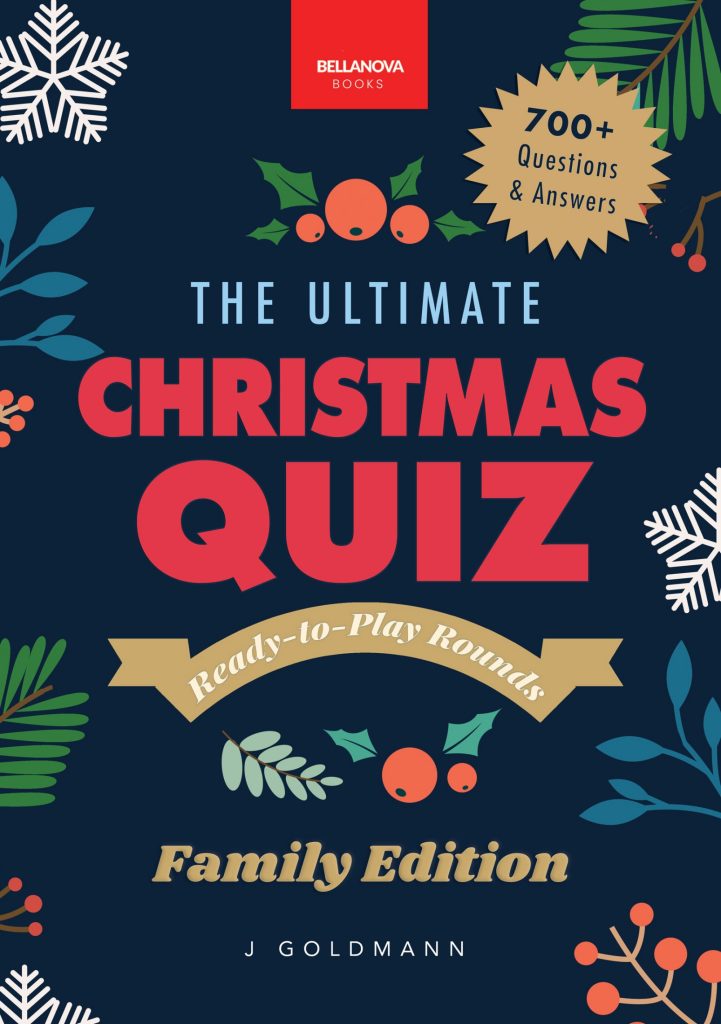
The Ultimate Christmas Quiz Book has 700+ questions and answers sorted into ready-to-play rounds: movies, carols, food, traditions, winter animals, science, the lot. There’s a mix of easy, medium and hard questions so kids and adults can play together, plus printable scorecards and host sheets. It’s zero prep for whoever got stuck hosting this year.
The Huge Book of Amazing Facts & Interesting Stuff: Christmas Edition is for people who’d rather just read the good stuff without being tested on it. It’s 700+ festive facts, from Christmas around the world to the economics of Christmas, and it makes a brilliant stocking filler for the person who always has a “well, actually…” ready.
Both are available in paperback and ebook. And if you’re after even more, I’ve got 20 weird Christmas facts here too (the one about mistletoe will put you off kissing under it for life).
Happy quizzing, and may you never get the bean.
Jenny x
If you click on a book link, I may receive a small commission, thank you for your support!